

FLESH TO TOUCH… FLESH TO BURN! DON’T KEEP THE WICKER MAN WAITING!
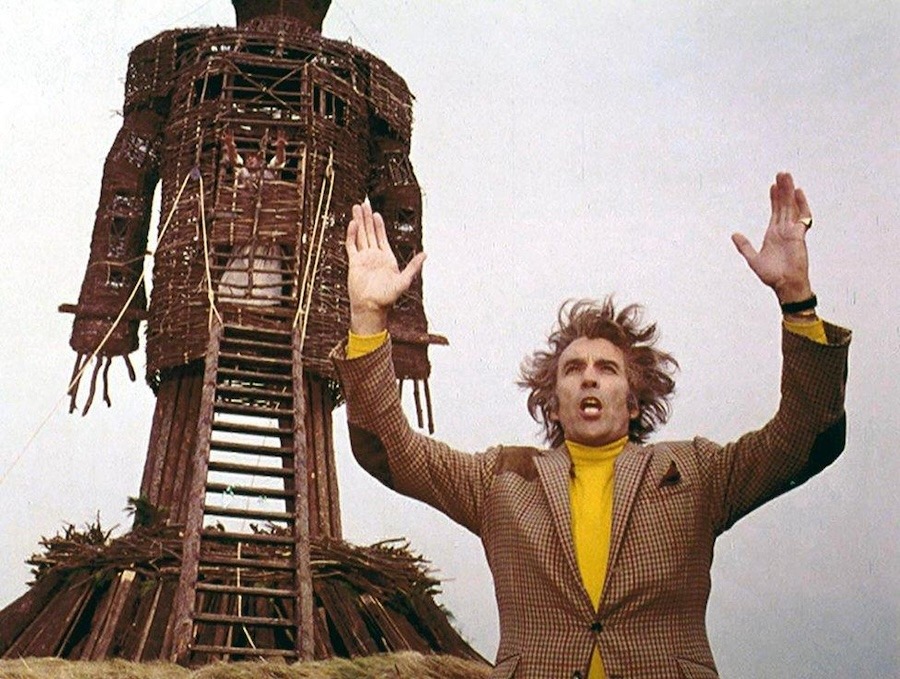
In the early 1970s, writer Anthony Shaffer had seen a fair share of horror movies and decided to write one of his own, one that would be quite different from the more conventional Hammer output. The film got made and even featured Hammer’s greatest star, Christopher Lee, but The Wicker Man came to be severely mistreated over the years. Key sequences were cut, others were simply lost. But it did become one of Britain’s most enjoyable cult classics and a “director’s cut” was eventually produced. This film deserves to be seen by more people. This man made of wicker deserves to be seen in his full glory.
Looking for a missing girl
Police Sergeant Neil Howie (Edward Woodward) arrives in the small Scottish island community of Summerisle. His mission is to find out what happened to a little girl called Rowan Morrison, who’s reported missing. He realizes that no one on the island wants to give him straight answers and Rowan’s mother denies that she’s missing. She even produces a girl she calls Rowan who looks nothing like the one seen in a photograph that Howie received from an anonymous tipster.
The fact that everyone in the village seems to be lying bothers Howie, but perhaps not as much as all the displays of sexuality and pagan worshipping that goes on everywhere. Howie is a devout Christian and Summerisle has turned its back on Christ, much to the satisfaction of its mysterious leader, Lord Summerisle (Lee). As Howie comes closer to the missing girl, the island threatens to consume him.
Quite erotic and strangely fascinating
Shaffer and director Robin Hardy make no mistakes bringing this cleverly structured story (inspired by David Pinner’s horror novel, which borrowed from Agatha Christie and the occult) to the screen. But they are not the only ones who deserve praise. The folk music, arranged by Paul Giovanni, is very memorable, heavily featured in several sequences that play more or less like early music videos. In earlier versions of the film, these were shortened or cut, presumably by people who did not understand their value. Without them, The Wicker Man is merely a good thriller about crazy people on an island. With those scenes intact, the film is great, defying any attempt to categorize it by genre.
There’s so much here likely to haunt viewers and inspire discussions.
Some of them are quite erotic, all of them are strangely fascinating. Take for example that orgy where even the snails on a leaf are having sex. Or the scene where Britt Ekland drives Howie crazy by dancing in the nude. How about the children preparing for May Day? The people of Summerisle happily singing as the wicker man burns? There’s so much here likely to haunt viewers and inspire discussions. Equally unforgettable is the performance of Edward Woodward, at first making us laugh at his proudly prudish police sergeant, then making us feel for this Christian who cries out to God for help (much like the biblical Daniel in the furnace).
Woodward’s is the most accomplished performance, even if Lee is terrific; a friend of mine thinks the Hammer star shares a resemblance with Cher in the final sequences, and this is the kind of film where you think, why the hell not? The two stars are ably supported by fine actors portraying the friendly but deluded population of Summerisle.
Is this a film worth recommending to hardcore horror fans? After all, it was Shaffer’s intention to make a film in that genre. While he had no interest in throwing blood and gore at the audience, there’s still startling originality on display. This is a film that turns increasingly unpleasant near the end. Expect no compromise.
The Wicker Man 1973-U.K. 99 min. Color. Directed by Robin Hardy. Screenplay: Anthony Shaffer. Novel: David Pinner (”Ritual”). Cast: Edward Woodward (Neil Howie), Christopher Lee (Lord Summerisle), Britt Ekland (Willow MacGregor), Diane Cilento, Ingrid Pitt, Lindsay Kemp.
Trivia: The original release ran 88 minutes. At one point, Michael Winner considered filming Pinner’s novel, with John Hurt in the lead. Michael York and David Hemmings were offered the lead in this project, but declined. Later a stage play. Followed by The Wicker Tree (2011). Remade in the U.S. as The Wicker Man (2006).
Last word: “One has to look at it through the perspective of recent history. Scotland was traditionally quite puritan, much more so than the rest of the British Isles. You couldn’t get a drink in Scotland on Sunday, there were all sorts of things you couldn’t do, and that era was just ending when we made that film. So Howie was a believable part of that. I don’t think that Howie today would be as believable a character, he has to be seen in context of the seventies and before.” (Hardy, Mung Being)