

AT THE EDGE OF THE WORLD, HIS JOURNEY BEGINS.
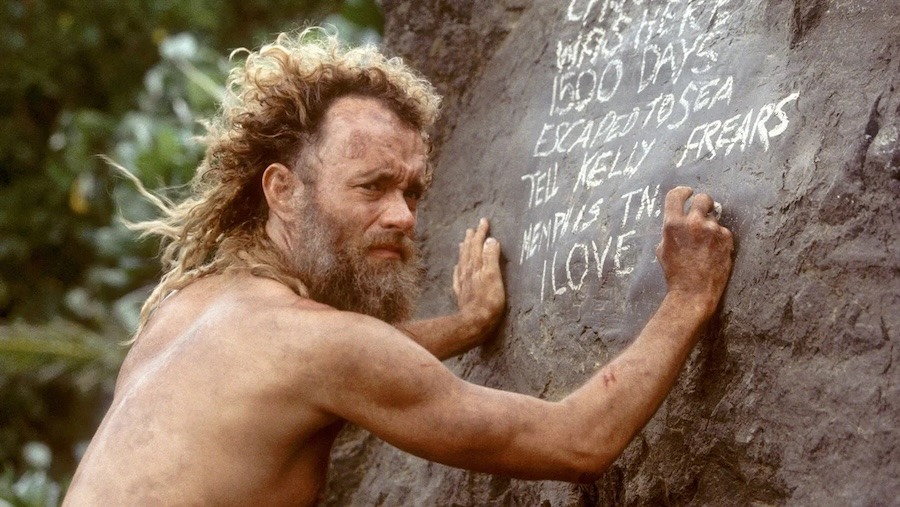
We’ve all watched too many episodes of Survivor to have a realistic idea of what it would be like to be stranded on a deserted island. This film, reuniting director Robert Zemeckis with his Forrest Gump star, takes a realistic look at a potentially romantic situation and reveals its horrors. The result is gripping, not least thanks to the fact that it is one of writer William Broyles, Jr.’s best screenplays. There is also something to be said about a film that turns a volleyball into an individual in such an emotional way that there was talk of this object deserving a Best Supporting Actor nomination.
Forced to take a business trip
The story introduces us to FedEx executive Chuck Noland, preaching the value of time to his new employees in Russia. He returns to Memphis where his girlfriend, Kelly Frears (Helen Hunt), waits for him. They’re about to spend Christmas together, but Chuck is suddenly forced to take a business trip. While the plane is waiting for him, Kelly gives him a pocket watch, containing a photo of herself, and Chuck gives her an engagement ring. As he walks up to the plane he tells her, “I’ll be right back”. Right then and there we know that he’s doomed.
The plane flies straight into a storm and crashes somewhere in the Pacific Ocean. Chuck, the only survivor, washes ashore on an island together with all kinds of wreckage from the plane. The first period on the island becomes a challenge. Chuck keeps waiting for rescue to arrive, but figures out in the meantime how to make fire, build a shed, feed himself and explore parts of the island. But what if help never arrives?
Shockingly effective crash
So much is great in this film. Not every detail of the plane crash may be realistic, but it is shockingly effective and brilliantly directed, one of the most harrowing ever seen on the big screen. To Chuck, life on the island may be dull, but nevertheless riveting to us. The filmmakers create tension with very small means; for instance, if you get a toothache in a place where you’re all alone, what do you do?
Accompanying all that is Alan Silvestri’s admirably sparse, sad score.
The tragedy of all those years on the island is heartbreakingly well captured by Zemeckis – the pathetic relationship between Chuck and a volleyball he’s given a face and christened Wilson; the specter of suicide; the harsh reality of life after a daring trip on a raft; the perfect, open ending to the tune of Elvis Presley’s “Return to Sender”. Accompanying all that is Alan Silvestri’s admirably sparse, sad score; Zemeckis knows when to use it to greatest effect, and the beauty of the island and the ocean is superbly realized by cinematographer Don Burgess.
Tom Hanks is captivating as the man whose job made him a control freak, but whose accident brutally taught him how little that job mattered absent the control. The film is a tragedy, but has a sense of humor, especially thanks to Hanks, one of the screen’s most likable stars ever. His amusing banter with Wilson makes us believe in that character and fear for its life when it is in jeopardy. Bizarrely enough, it is those emotions that lie at the heart of this existentialist drama.
Cast Away 2000-U.S. 143 min. Color. Directed by Robert Zemeckis. Screenplay: William Broyles, Jr. Cinematography: Don Burgess. Music: Alan Silvestri. Cast: Tom Hanks (Chuck Noland), Helen Hunt (Kelly Frears), Nick Searcy (Stan), Lari White, Chris Noth, Jenifer Lewis.
Trivia: Co-produced by Hanks and Zemeckis. Since Hanks some time into production needed to lose weight and transform into a person who had spent four years on a deserted island, filming was halted for a period; in the meantime, Zemeckis made What Lies Beneath (2000).
Golden Globe: Best Actor (Hanks).
Last word: “We used a lot [of CGI] on Cast Away. Huge. Way more [than Forrest Gump]. It’s like everything was a digital shot. We had whole fleets of ships that we had to remove. We had other entire islands that were in the shots that we had to remove. That was a huge effects show.” (Zemeckis, DGA)