
BEFORE THE FALL OF THE BERLIN WALL, EAST GERMANY’S SECRET POLICE LISTENED TO YOUR SECRETS.
It’s a day like many others. A group of Stasi agents have discreetly broken into an apartment and bugged it. It doesn’t take long, but as they leave the apartment the leader of the group spots movement behind the neighbor’s door eye. He knocks on the door and when a frightened lady opens, he tells her that if she wants her son to succeed in medical school she had better not tell her neighbor about what she saw. This is life in mid-eighties East Germany.
How to spot a lie
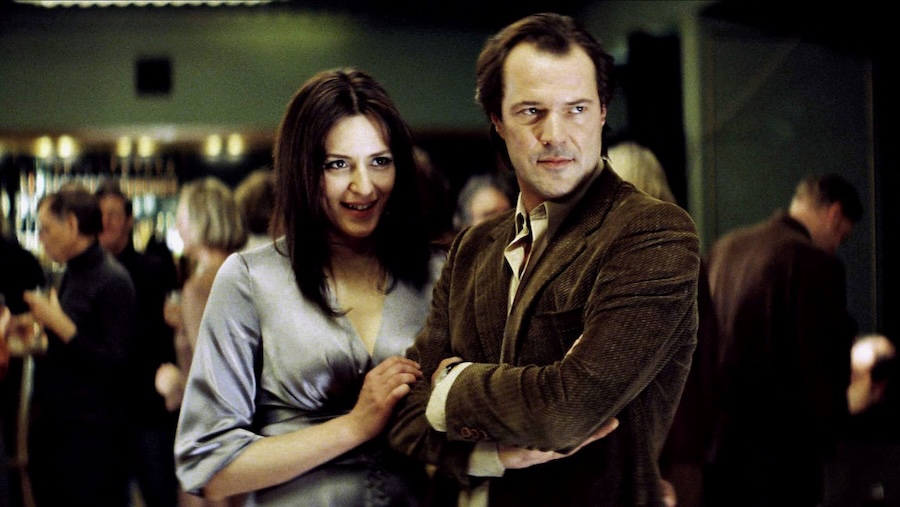
The leader of the group is Gerd Wiesler (Ulrich Mühe), a respected, seasoned professional. In the opening sequence, he lectures a group of young agents on the issue of interrogation, showing them how you spot a lie and then wear the suspect down by asking the same questions for hours and hours, denying him any kind of respite. The young agents are impressed. Then one night Wiesler goes to the theater with his superior officer who tells him about the writer of the play, Georg Dreyman (Sebastian Koch), and the actress he’s sharing an apartment with, Christa-Maria Sieland (Martina Gedeck). In the sophisticated circles of East Berlin, they’re a beloved couple; there have been times when the authorities suspected them of disloyalty, but they have nothing on them.
Wiesler refuses to believe in their innocence; after all, they are artists. Besides, Dreyman’s mentor is a well-known dissident who is not allowed to work anymore as a stage director. Wiesler decides to open a file on the couple, bugs the apartment, and starts listening 24/7 with the help of a younger agent.
Holding a people hostage
The East Germany that we see in this film is indeed a frightening place to live, without much humanity. People are not shot in the streets, at least there’s that, but the sequence I described in the beginning shows how effectively the government and its security forces hold the people of a country hostage. The powers that be depend on the system of informers, and they are everywhere.
Ever since reunification in 1990, there have been those who feel misplaced in the new Germany and harbor nostalgia for the old dictatorship, perhaps part of a conservative longing for a time when everybody knew their place and there was less confusion? This lauded drama serves as a reminder of everything that was wicked in the East. Writer-director Florian Henckel von Donnersmarck points out the absurdities of the system, showing us insane little details like how the Stasi would remove and store the seat of a chair where a suspect had been sitting, just in case dogs would be needed in the future to hunt him down. Sieland and Dreyman are human beings of flesh and blood, trying to survive in this society and helping other writers get their work published in West Germany.
Their story is touching, but more interesting is that of Wiesler. As a guardian of a soulless system, he has no life. Every day he comes home to an empty apartment in a building where many other Stasi agents live (do they bug each other, one wonders…?). Listening to people who have much richer lives, who read books, play music, make love and dream of a better world, opens his mind and changes him; the effect is moving. Mühe earned a lot of acclaim for his understated performance, and deserves it.
The definitive, engrossing and authentic portrait of one of history’s most absurd dictatorships
At its most absorbing in the opening and near the end, but on the whole The Lives of Others should be seen as the definitive, engrossing and authentic portrait of one of history’s most absurd dictatorships – and, interestingly enough, the flip side of the comedy Good Bye, Lenin! (2003).
The Lives of Others 2006-Germany. 137 min. Color. Widescreen. Written and directed by Florian Henckel von Donnersmarck. Cast: Martina Gedeck (Christa-Maria Sieland), Ulrich Mühe (Gerd Wiesler), Sebastian Koch (Georg Dreyman), Ulrich Tukur, Thomas Thieme, Hans-Uwe Bauer.
Trivia: Original title: Das Leben der Anderen.
Oscar: Best Foreign Language Film. European Film Awards: Best Film, Actor (Mühe), Screenwriter. BAFTA: Best Foreign Language Film.
Last word: “An important question in moral philosophy or applied ethics is how much room you should give your principles. And how much room do you give your feelings? The ideologue is somebody for whom everything is about principles. He does not pay attention to his feelings, which is a dangerous position because it means you have to shut off so much within yourself. If Lenin says, ‘I cannot listen to Beethoven’s Appassionata anymore, because if I do it makes me feel soft inside, and I cannot kill people anymore,’ then that means I don’t even want to react to my feelings. But feelings are as valid an informer for moral decision-making as intellectually derived principles. That’s something which can be hard for people to understand, and it was almost impossible for the Communists to understand. I thought it would be interesting to explore the journey of someone who is forced to rediscover feelings.” (von Donnersmarck, Film 4)