

THE PICTURE THAT HAS THE NATION LAUGHING. IT’S SO FUNNY IT HAS HOLLYWOOD HYSTERICAL. YOU CAN’T HELP BUT ENJOY IT.
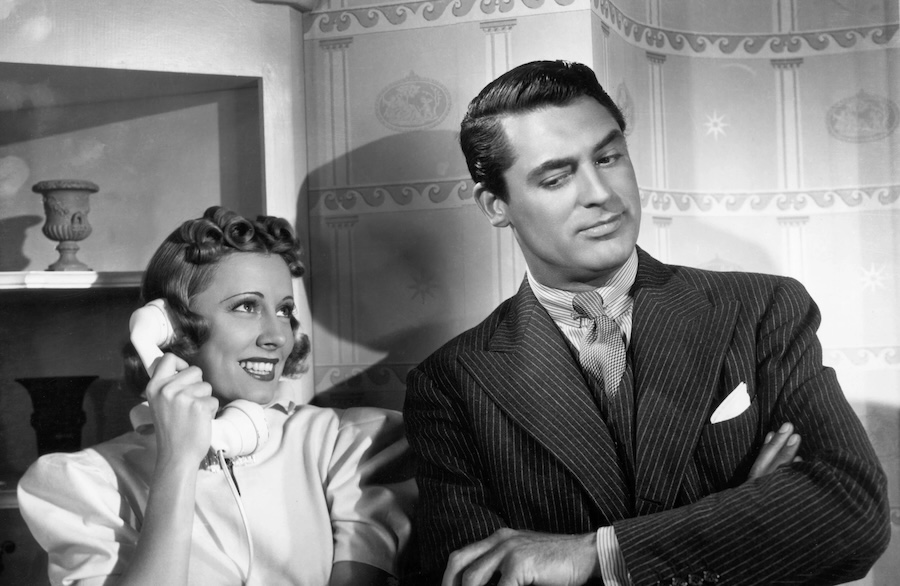
Columbia chief Harry Cohn was not happy with Leo McCarey’s behavior on the set of The Awful Truth. Cohn thought the director was wasting time, telling stories and playing the piano, when he should be focusing on making a better comedy than Frank Capra ever could. After a public display of anger, where he had ordered the set cleared, Cohn confronted McCarey – who stood his ground. The director told Cohn that if he wanted him back on set, he should apologize to everyone there, including Harold Lloyd, who was a visitor on that day.
In the end, Cohn gave up and apologized, thinking the movie could in any case be written off as a loss. He was wrong about McCarey, and The Awful Truth. The picture was a box-office hit and garnered six Oscar nominations, as well as a win for Best Director. There was a method to McCarey’s madness.
Coming back from “Florida”
The state of the Warriners’ marriage isn’t great. Jerry (Cary Grant) has just been away for two weeks, but it sure as hell wasn’t in Florida, which is what he told his wife Lucy (Irene Dunne). She, on the other hand, has spent a lot of time together with her voice teacher, Armand Duvalle (Alexander D’Arcy). When Jerry finally comes home, only to find Lucy in Duvalle’s company, they both decide they’ve had enough. A judge agrees to a divorce and they have 90 days to finalize it. In the meantime, both Jerry and Lucy either date or are courted by several men and women, prompting the other to sabotage potential love affairs.
A lack of trust
Cohn wasn’t the only one who was unhappy with McCarey’s method. The first week of production was catastrophic, with no script (as it was desperately being rewritten by among others McCarey) and three lead actors who were beginning to feel that they had made a huge mistake. Grant in particular wanted out of the project and tried to make a deal with McCarey and Cohn, who refused. None of the actors trusted McCarey’s belief in improvisation as a key to great comedy, but slowly things began to change. The director started gaining the actors’ trust by showing that he knew how to take advantage of their strengths, and his efforts to bring that out of Dunne and Grant in particular became one of the film’s greatest assets.
With Leo McCarey’s help, Cary Grant and Irene Dunne make it work to hilarious effect.
The two stars are simply perfect together, and it’s not just because they end up in crazy, funny situations, but also because of how they behave in each other’s company. It’s the little things, like darting eyes, smirks, noises; mannerisms that illustrate both annoyance and understanding between them. With McCarey’s help, Grant and Dunne make it work to hilarious effect and it’s been argued that especially Grant used what he learned throughout his career, as part of his screen persona.
The cast also has a good comedy performance by Bellamy as an Oklahoma oilman, a mama’s boy who starts dating Lucy… and let’s not forget Skippy, one of the era’s most famous dogs. Primarily known as Asta in the Thin Man movies, Skippy plays the Warriners’ beloved Mr. Smith who becomes part of the divorce proceedings.
Originally based on a play (and twice filmed before, in 1925 and 1929), The Awful Truth has a script that differs a lot from Arthur Richman’s work. Essentially divided into two halves, one dominated by Dunne’s Oklahoma flirt, the other by Grant dating an heiress, McCarey made sure to add a lot more screwball comedy and even saw to it that some risqué jokes were accepted by the Hays Office. This is ultimately a smart and hilarious comedy, one of the genre’s best, with bright dialogue and a wonderful ending that uses props and symbolism to great effect.
The Awful Truth 1937-U.S. 91 min. B/W. Directed by Leo McCarey. Screenplay: Viña Delmar. Play: Arthur Richman. Editing: Al Clark. Cast: Irene Dunne (Lucy Warriner), Cary Grant (Jerry Warriner), Ralph Bellamy (Dan Leeson), Alexander D’Arcy, Cecil Cunningham, Molly Lamont.
Trivia: Tay Garnett was first offered to direct. Remade as a musical, Let’s Do It Again (1953).
Oscar: Best Director.
Last word: “The Awful Truth, which brought me an Oscar, was a film whose shooting gave me real pleasure. Irene Dunne, Carey Grant and Ralph Bellamy never posed a problem for me. It was one of the films I shot most rapidly. And what also pleases me is that I told, somewhat, the story of my life (don’t repeat it: my wife will want to kill me…). But the few scenes turning on the question of faithfulness, I should hasten to say, were not at all autobiographical: my imagination alone is responsible.” (McCarey, Cahiers du Cinema)