
HE CHOPPED DOWN THE FAMILY TREE…
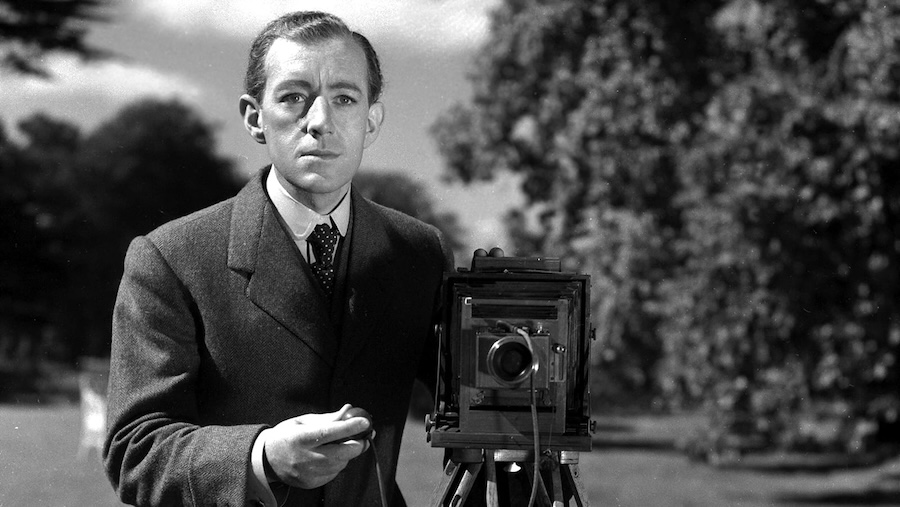
After playing Fagin in David Lean’s Oliver Twist (1948), a controversial role that required him to wear heavy makeup, including a prosthetic nose, Alec Guinness was relaxing on a beach in France when he started reading the script for a black comedy called Kind Hearts and Coronets. He didn’t get very far. Soon, the actor was laughing out loud and didn’t even bother finishing the script. The initial offer was for Guinness to play four parts, members of the aristocratic D’Ascoyne family, but he sent a telegram to his agent asking, ”Why four parts? Why not eight?!”
Guinness ended up playing nine members of the family, a performance that cemented the theater legend’s status as a rising star in British cinema.
Waiting to be hanged for murder
The story begins in the early years of the 20th century, in a jail cell where the 10th Duke of Chalfont (Dennis Price) is waiting to be hanged for murder and begins to write his memoirs. His mother was the daughter of the 7th Duke who eloped with an Italian opera singer and was disowned by her family. Louis was raised without his father, because he died at an early age, but his mother told him all about her previous life as the daughter of a duke. There was a desire on her part to reconnect with her family and she tried to gain financial help from them, but was rebuffed. Even her final request, to be interred in the family vault at Chalfont Castle, was rejected. Instead, she was buried in a common grave, causing lasting resentment. Louis decided to take back what he considered rightfully his, the title and the castle. All he needed to do was to kill the eight people in succession to the dukedom.
A sharp, unsentimental satire
The year 1949 was exceptional in the history of the British film studio Ealing. Three great comedies were released: Passport to Pimlico, Whisky Galore! and Kind Hearts and Coronets. My favorite remains this one, a sharp, unsentimental satire of class and sexual repression where a brilliant story is one of the main assets. Roy Horniman’s 1907 novel was adapted with a few crucial changes. The murder of a child was not going to be part of this film project; Louis’s racial identity was also changed, because of ingredients in the novel that could be interpreted as anti-Semitic. Producer Michael Balcon had to be talked into agreeing to make a comedy about so many murders, but director Robert Hamer, who had already made a few films for Ealing, saw a chance to challenge moral conventions, perhaps not unexpected from a gay man in the 1940s. Along with co-writer John Dighton, Hamer finds a playfulness in his portrayal of Louis’s quest; members of the D’Ascoyne family quickly fall victim to murder, but in absurd ways.
The last scene is a masterpiece, as Louis faces a choice in terms of women he’s desired, and also a mistake that will cost him everything.
At the same time, there’s always a darkness present in the story; Louis keeps a stiff upper lip, but there’s a righteous fury boiling inside of him. There’s also lust – after his childhood friend Sibella (Joan Greenwood) who rejects him for someone she considers more prosperous; and Edith (Valerie Hobson), the wife of a younger D’Ascoyne, whom Louis decides should be his duchess as soon as all the other D’Ascoynes are disposed of. The last scene is a masterpiece, as Louis faces a choice in terms of women he’s desired, and also a mistake that will cost him everything. Chance plays a great role in the story, as Louis tries different ways of reaching his sinister goals.
Price delivers a low-key, cold performance that suits his character well, and obviously Guinness is a hoot as the D’Ascoynes, including his roles as the elderly bishop who enjoys his port, and the magnificent suffragette Lady Agatha.
Kind Hearts and Coronets 1949-U.K. 104 min. B/W. Directed by Robert Hamer. Screenplay: Robert Hamer, John Dighton. Novel: Roy Horniman (”Israel Rank: The Autobiography of a Criminal”). Cast: Dennis Price (Louis Mazzini/Mazzini the elder), Alec Guinness (playing virtually the whole D’Ascoyne family), Valerie Hobson (Edith), Joan Greenwood, Miles Malleson, Hugh Griffith.
Trivia: The film was adapted for radio several times and as a Broadway musical, ”A Gentleman’s Guide to Love and Murder”; it also inspired the film How to Make a Killing (2026).
Last word: “What were the possibilities which thus presented themselves? Firstly, in that of making a film not noticeably similar to any previously made in the English language. Secondly, that of using this English language … in a more varied and, to me, more interesting way than I had previously had the chance of doing in a film. Thirdly, that of making a picture which paid no regard whatever to established, although not practised, moral convention.” (Hamer, “Kind Hearts and Coronets”)