
A SCREEN EVENT TO BE REMEMBERED FOR ALL TIME!
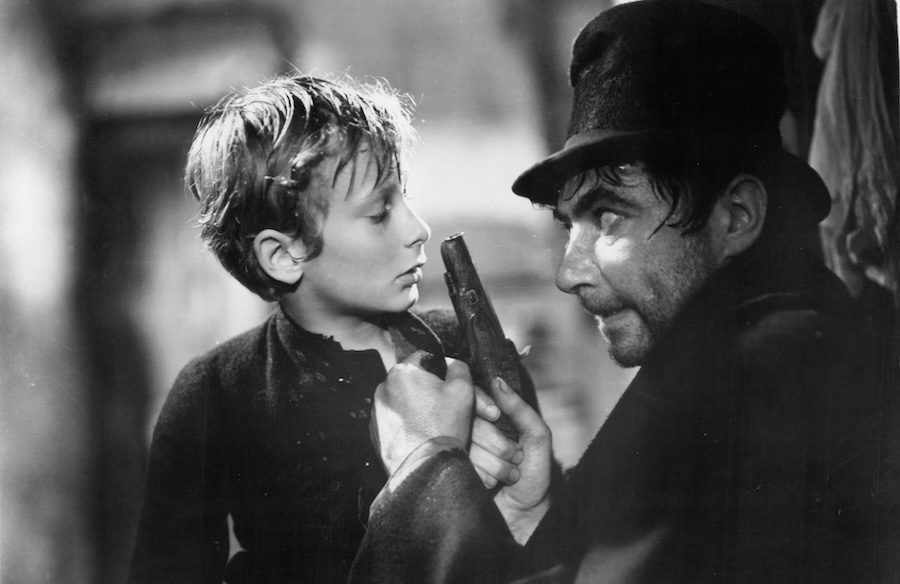
There are stories about David O. Selznick attacking Alec Guinness at a party over his portrayal of Fagin in this film, accusing him of anti-Semitism. He wasn’t the only one; in fact, David Lean’s Oliver Twist suffered a severe backlash for that reason. The film had trouble finding international distributors. In Germany, the mayor of Berlin signed a petition to have it removed from cinemas. The film was labeled anti-Semitic in Israel and banned; Egyptian authorities also banned it because they thought it didn’t go far enough in demonizing Jews. Oliver Twist didn’t reach American shores until 1951, and it was only screened after 12 minutes were removed.
Hollywood didn’t care to lavish the film with any Oscar nominations, but Guinness’s performance remains one of its major assets.
Raised in a workhouse
After battling a storm, a woman reaches a workhouse and gives birth to a boy. She dies, but the child is given the name Oliver Twist and raised there. Conditions are dire, especially since the two individuals who run the institution, Mr. Bumble and Mrs. Corney (Francis L. Sullivan, Mary Clare) are only interested in making as much money as possible, keeping the children virtually starving. After ending up in the care of a caretaker, which ends in violence, Oliver runs away and reaches London, where he’s noticed by The Artful Dodger (Anthony Newley), a pickpocket who’s part of a gang run by Fagin (Guinness). Oliver becomes a sort of apprentice, learning the tricks of the trade…
Windy opening scenes
In 1946, director Lean had turned Charles Dickens’s ”Great Expectations” into a cinematic masterpiece; many of that film’s collaborators returned for another Dickens adaptation. Two men had won Oscars for the last movie, cinematographer Guy Green and art director John Bryan. Once again, their contributions are brilliant, from the windy opening scenes where Oliver’s mother is struggling to reach safety, to the magnificently dirty-looking and imposing sets that represent London’s poor areas in the mid-19th century, part of which play a huge role in the impressively staged climax where a mob is chasing Fagin and his most wicked associate, Bill Sykes (Robert Newton).
Alec Guinness is the stand-out performer in the cast, deliciously devious and manipulative.
There are many memorable scenes here, including the one where the starving children watch the workhouse staff as they’re having a feast of a meal. A fierce attack on child labor and the social ills of 1830s London, as Dickens intended in his novel. Lean and Green paint the story in black, but still make us care about Oliver; one reason is John Howard Davies’s likable turn as the child who finds a world full of malevolent adults. The cast is full of enthusiastic performances, including Sullivan as Bumble and the director’s wife, Kay Walsh, as a prostitute who’s trapped in Fagin’s world; she had been one of the writers on Great Expectations, and reportedly also came up with this film’s opening scene. But Guinness is the stand-out performer in the cast, deliciously devious and manipulative as Fagin. Anti-Semitic caricature or not (and I suppose we’ll keep debating that point), the perhaps excessively prominent makeup was based on George Cruikshank’s illustrations in the novel.
Lean’s take on the Dickens classic remains the definitive adaptation, one that inspired subsequent interpretations, including the musical ”Oliver!” (which was also filmed). Together with Great Expectations, the movie gives us an idea of early Victorian England that resonates because both films create such a dark and stylish vision of the time and place, to a greater extent than Hollywood filmmakers were able to conjure.
Oliver Twist 1948-U.K. 116 min. B/W. Produced by Ronald Neame. Directed by David Lean. Screenplay: David Lean, Stanley Haynes. Novel: Charles Dickens. Cinematography: Guy Green. Art Direction: John Bryan. Cast: Alec Guinness (Fagin), Robert Newton (Bill Sykes), John Howard Davies (Oliver Twist), Kay Walsh, Francis L. Sullivan, Anthony Newley, Diana Dors.
Trivia: Robert Donat was reportedly considered as Sykes.
Last word: “I approached David Lean, saying, ‘I would love to play Fagin,’ and I was what, 34-35, something like that. […] ‘You’d never think of casting me as Fagin.’ […] ‘That’s where you are wrong. Because you people in films are only interested in types, you’re not interested in anyone actually trying to act.”” (Guinness persuading Lean, “Talking Pictures”)